Find answers to the most common questions about the tepeo ZEB, including how it works, whether it is right for your home, installation, running costs, smart tariffs and carbon savings.
If you can’t find the answer to your question, please get in touch, we’ll be happy to help.

A heat battery boiler is an electric heating system that stores energy as heat, then releases it through your home’s wet central heating system when you need heating or hot water.
The tepeo ZEB is a heat battery boiler designed as a practical replacement for fossil fuel boilers and expensive direct electric heating in suitable homes.
The ZEB is tepeo’s smart heat battery boiler. It uses electricity to charge up and store energy as heat inside its core, then delivers that heat through your central heating system when your home needs it.
It is designed to work with familiar wet central heating systems, including radiators or underfloor heating, giving you the comfort of a boiler without burning gas, oil or LPG in the home.
The ZEB charges using electricity and stores that energy as heat. It then releases the stored heat into your central heating system when your home needs warmth.
Its smart charging algorithm works out when to charge based on your heating needs, the weather, your energy tariff and electricity carbon intensity. This helps the ZEB charge at cheaper and often lower-carbon times where possible.
It is both. The ZEB stores energy like a battery, but delivers heat through your central heating system like a boiler. That is why we call it a heat battery boiler. However unlike an electrical battery it cannot export electricity – it is designed to store the amount of energy you need for your heating.
Like a storage heater, the ZEB stores energy as heat. The difference is that the ZEB is designed to replace a boiler and connect to a wet central heating system.
It also has smart charging capabilities, meaning it can decide when to charge based on your tariff, weather forecast and expected heat demand. This helps your home use electricity more intelligently.
A gas, oil or LPG boiler burns fossil fuel in the home to create heat. The ZEB does not burn fossil fuels at the point of use. Instead, it uses electricity and stores that energy as heat.
It is designed to provide familiar central heating while helping suitable homes move away from fossil fuel heating.
Read more in our Better Boiler Guide.
A direct electric boiler uses electricity at the moment your home needs heat. This can mean using electricity during peak periods, when it is often more expensive and more carbon intensive.
The ZEB stores heat, so it can charge when electricity is cheaper and often cleaner, then use that stored heat when your home needs warmth. This makes it a smarter alternative to direct electric heating.
Read more about the differences between a heat battery boiler vs an electric boiler.
The ZEB can be a good option for homes where a heat pump is not the right fit, or where homeowners want a lower-disruption replacement for a fossil fuel boiler.
Heat pumps are highly efficient and work well in many homes. The ZEB offers another route to low-carbon heating for suitable properties, particularly where familiar central heating, existing radiators and lower disruption are important.
The ZEB is suitable for many homes with a wet central heating system, such as radiators or underfloor heating.
It is typically best suited to flats, bungalows, semi-detached and detached homes with annual energy usage up to 14,000kWh and heat loss under 5kW. We will check whether the ZEB is right for your home during your home survey.
The ZEB is typically suitable for homes with annual energy usage up to 14,000kWh and heat loss under 5kW.
Suitability depends on your property, heating system, hot water needs and how you use your heating. A tepeo home survey will confirm whether the ZEB is a good fit.
Yes. The ZEB is designed to work with wet central heating systems, including existing radiators, in suitable homes.
Your installer will check your heating system during the survey to make sure it is suitable.
Yes, the ZEB is designed to replace gas, oil, LPG or electric boilers in suitable homes.
It connects to a wet central heating system and provides heating through radiators or underfloor heating.
Yes, but you will need a hot water solution alongside the ZEB.
The ZEB is a heat-only boiler, so if you currently have a combi boiler, your installer will recommend a suitable hot water setup, such as a hot water cylinder, smart cylinder or another compatible solution.
Find out more about how to heat your water when switching from a combi boiler.
If you want the ZEB to provide hot water as well as heating, you will need a suitable hot water solution.
Many homes use a hot water cylinder. Your tepeoPRO installer will recommend the best option for your home.
The ZEB needs a wet central heating system, such as radiators or underfloor heating, to deliver heat around your home.
Almost all homes with storage heaters do not have any wet central heating. If your home still has a wet central heating system, the ZEB may be suitable. If not, additional changes would be needed.
No. The ZEB is only suitable for homes with a wet central heating system, because it needs pipes, radiators or underfloor heating to deliver heat.
The ZEB costs £6,000, including VAT and delivery.
Installation is not included in this price, as installation costs vary depending on your home, heating system setup and installer rates.
For a limited time only, we are offering £2,500 off your ZEB purchase as part of our early grant match.
Installation costs vary depending on your home, heating system and the work required.
Most installations are straightforward and take around 1–2 days, with no need to replace your radiators in many suitable homes. We can connect you with a registered tepeoPRO installer who can provide a quote tailored to your property.
The ZEB is not currently supported by the Boiler Upgrade Scheme.
However, heat batteries are expected to be included from winter 2026, with eligible households able to access a £2,500 grant once the relevant standards and scheme rules are in place.
Until then, tepeo is offering a £2,500 early grant match for eligible customers. Terms apply.
Your heating costs will depend on your home’s heat demand, your current heating system, your electricity tariff and how your ZEB is set up.
The ZEB is designed to work best with time-of-use tariffs, where it can charge when electricity is cheaper and store that heat for later. The best way to estimate your costs is to use our cost and carbon calculator or complete a home check.
Find out more about energy tariffs for your heat battery boiler.
Running costs depend on your home, heat demand and electricity tariff.
The ZEB is designed to make electric heating more affordable by charging when electricity is cheaper. However, gas may still be cheaper in some homes depending on tariffs and usage.
Use our cost and carbon calculator to estimate your likely running costs.
In many cases, yes.
A direct electric boiler uses electricity when heat is needed, which can mean using expensive peak-rate electricity. The ZEB stores heat and can charge during cheaper off-peak periods, helping reduce running costs compared with direct electric heating.
Find out more about electric boilers vs heat battery boilers.
We recommend a time-of-use tariff with one or more off-peak periods.
These are often marketed as EV tariffs or flexible electricity tariffs. Suppliers such as Octopus, OVO, EDF and others offer time-of-use tariffs, although the best tariff for you will depend on your home, heating demand and other electricity use.
Dynamic tariffs can also work well with the ZEB because they allow it to take advantage of lower-cost periods and, where available, surplus renewable generation.
Find out more about energy tariffs for your heat battery boiler.
Yes. Octopus Agile is a dynamic tariff with a different electricity price every half hour.
The ZEB can automatically optimise charging for tariffs like Octopus Agile.
You will usually need a smart meter to access lower-cost time-of-use tariffs from your energy supplier.
The ZEB can still optimise charging to minimise carbon without a smart meter, but a smart meter is likely to give you access to the tariffs that make the most of the ZEB’s flexibility.
Explore real customer stories to see how the tepeo heat battery boiler works in different types of homes, from apartments and townhouses to bungalows and older properties.
Hear directly from ZEB owners about why they chose a heat battery boiler, what it’s like to live with day to day, and what advice they would give to others considering the switch.
Most ZEB installations take around 1–2 days, depending on your home and heating setup.
Your installer will confirm the expected installation time after your home survey.
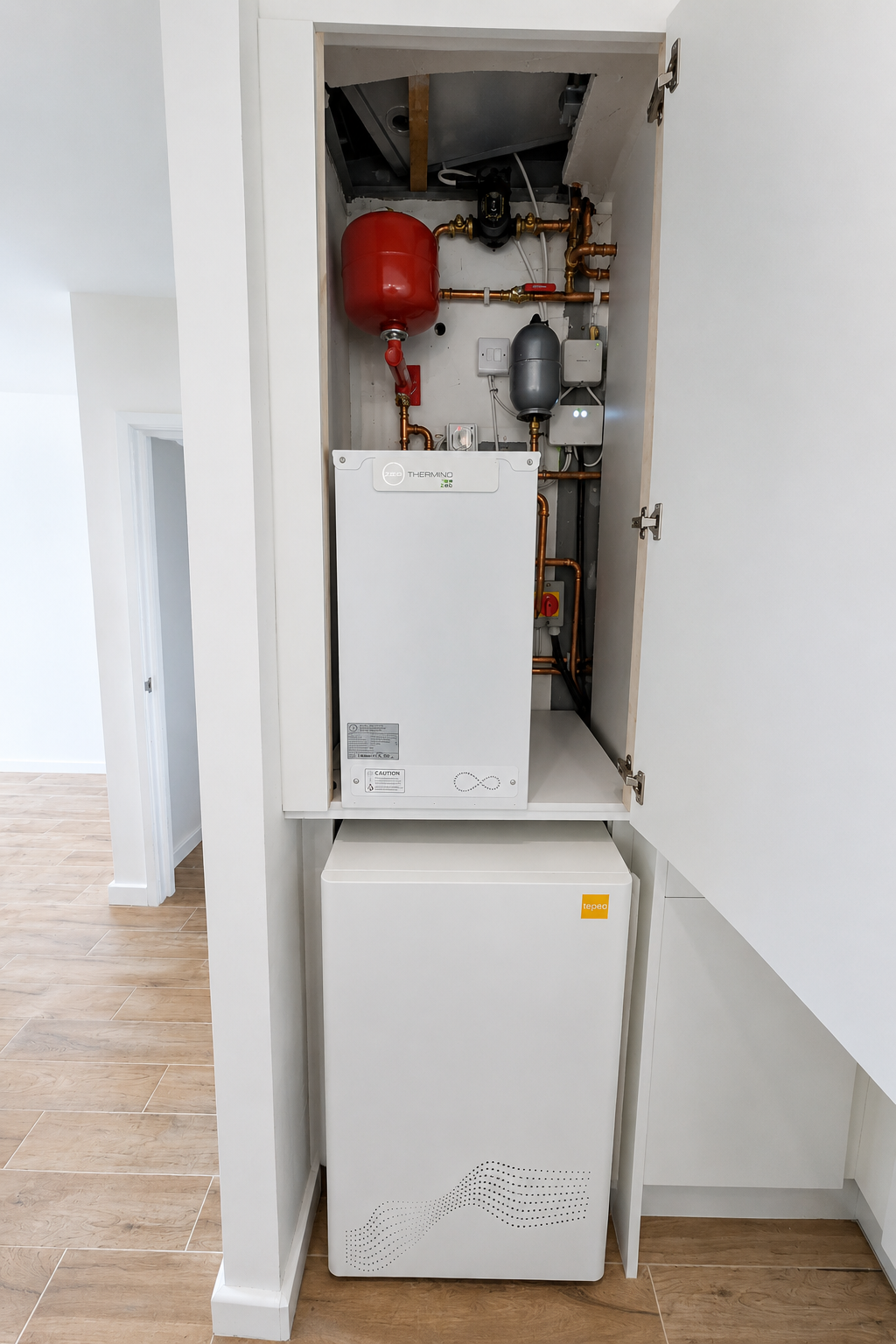
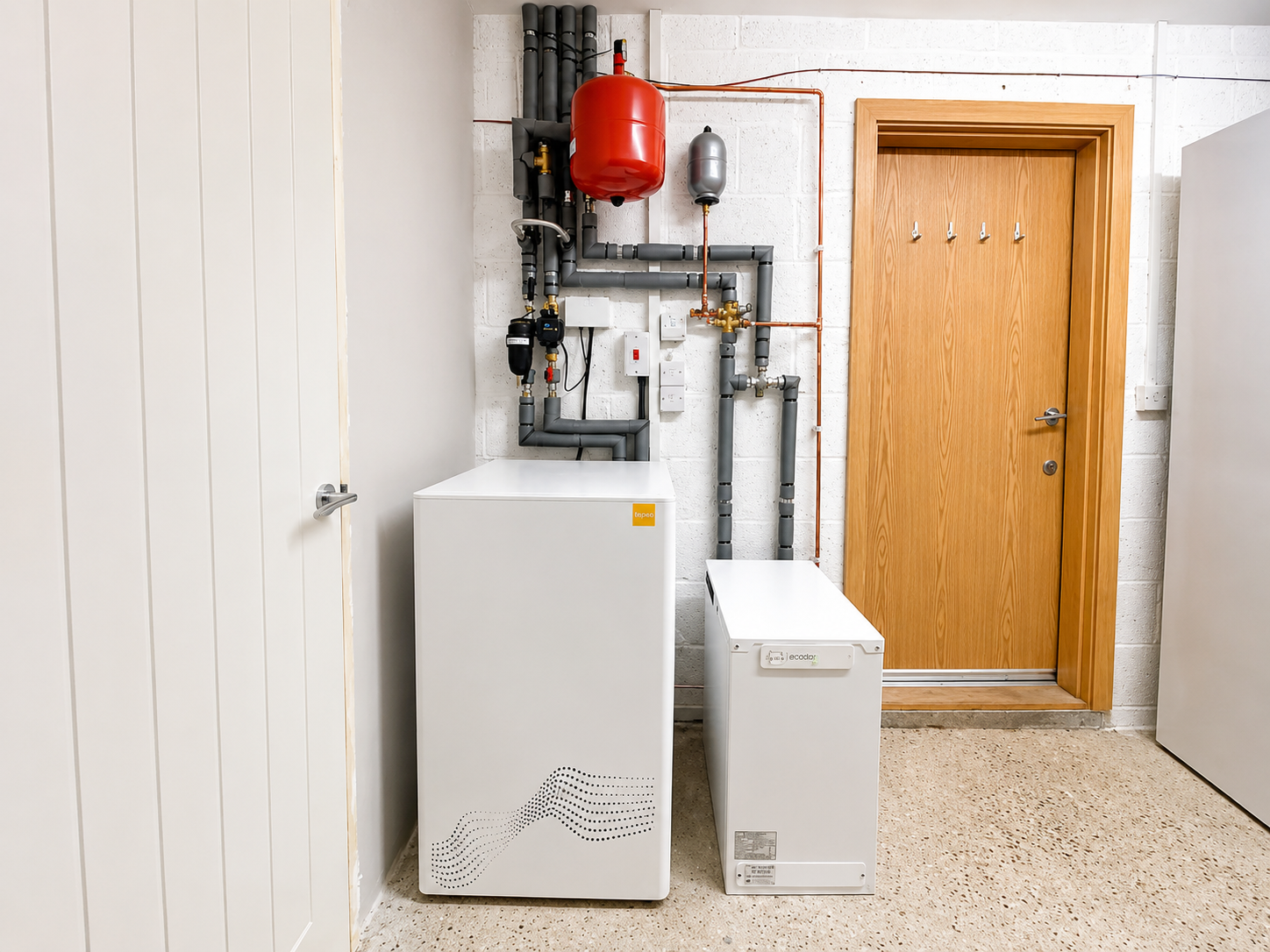
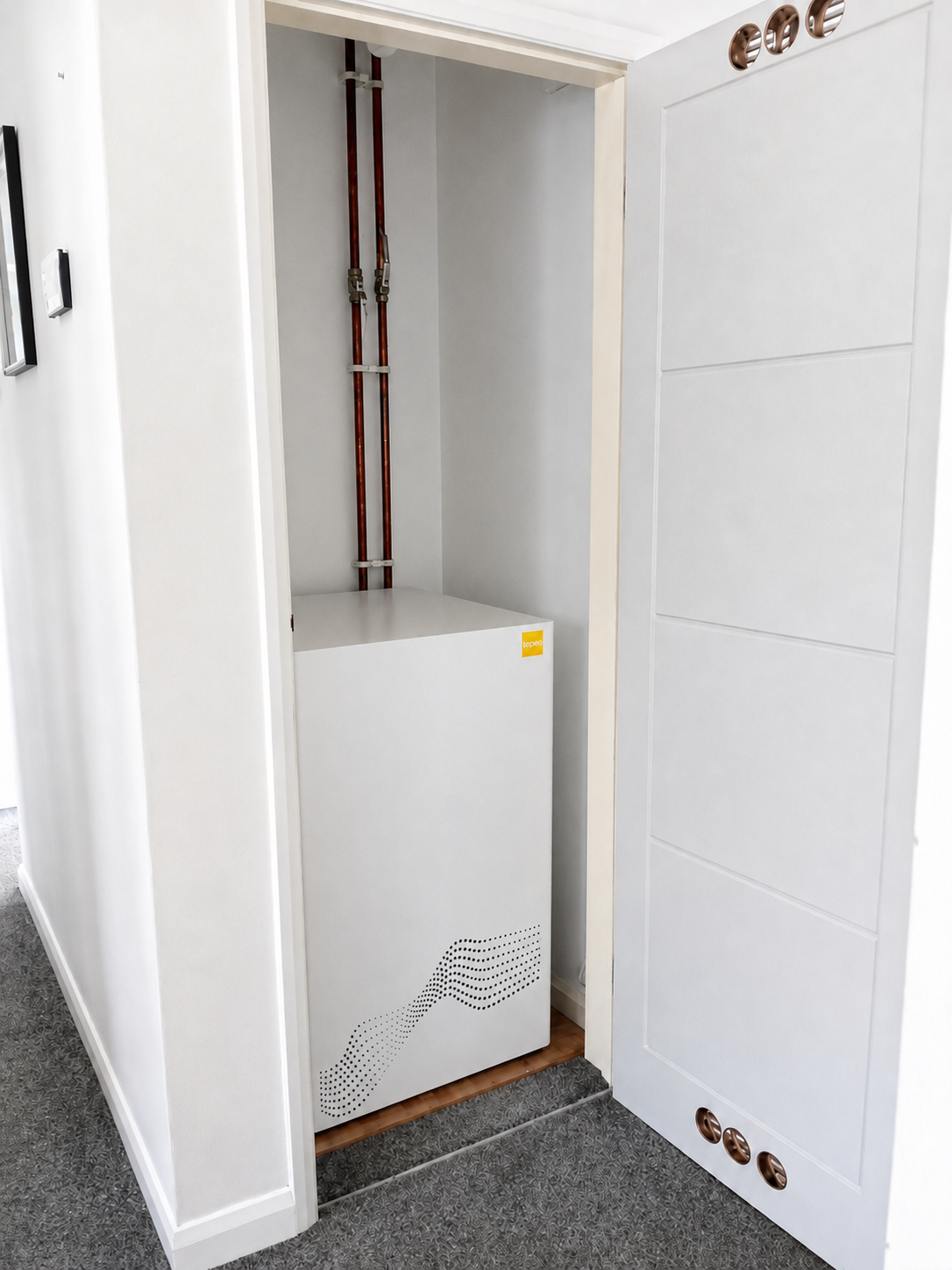
The ZEB needs to be installed in a suitable indoor space.
Common locations include utility rooms, cupboards, basements and garages. Your tepeoPRO installer will advise on the best location for your home.
The ZEB is:
It also needs a clearance of 7.5cm above and 5cm on all sides. In some situations this clearance can be reduced, and your tepeoPRO installer will advise.
You can find lots more technical information in our ZEB datasheet.
The ZEB weighs 375kg. That may sound like a lot but it’s about the same as a large upright piano or a hot water cylinder
Because of this, it needs to be installed in a location with suitable access and floor support.
No. The weight of the ZEB makes lifting it into a loft impractical.
Yes, if access is suitable. For example, your basement would need a steel or concrete staircase that is not too narrow.
Your installer will assess access during the survey.
No. The ZEB needs to be installed in a weatherproof, insulated environment, so it should be somewhere inside the home or in a suitable internal space.
Yes, the ZEB can be installed in a garage, but ideally only in a converted garage used as a heated space
However, the ZEB does lose some heat to the surrounding space. If it is installed outside the heated part of your home, those heat losses will warm the garage rather than contributing to heating your home.
Your installer will advise whether a garage installation is suitable.
Yes. The ZEB needs an internet connection so it can use smart charging and stay connected to the tepeo App.
This can be provided through Wi-Fi or Ethernet. The ZEB is resilient to temporary connection outages. If you can’t get Wi-Fi access it’s also possible to install a 4G Wi-Fi dongle.
The ZEB can use Ethernet as an alternative to Wi-Fi.
Your installer can advise on the best way to provide a reliable internet connection in the installation location. If you can’t get Wi-Fi access it’s also possible to install a 4G Wi-Fi dongle.
The ZEB stores 40kWh of usable thermal energy.
This refers to how much heat it can store at one time, not how much heat your home uses across the year.
The ZEB takes around 4–5 hours to charge from empty.
It can start delivering heating after around half an hour from cold.
How long a full charge lasts depends on your home, heating usage and the weather.
A larger or less efficient home will use stored heat faster than a smaller or more efficient home. The ZEB can also top up during the day if needed.
The ZEB can output up to 15kW.
The ZEB can supply water temperatures from 35°C to 80°C in a suitably sized home. This is customisable in the tepeo App.
This is similar to a fossil fuel boiler, so in a suitable property you should not notice a difference in the way your radiators feel.
When installed inside the heated part of the home, the ZEB is classed as 100% efficient at converting electricity into heat for EPC purposes.
If installed in an unheated space, such as a garage, some heat losses may not contribute to warming the home. This can reduce overall system performance.
In a suitable home, the ZEB is designed to behave like a conventional boiler.
It provides heat through your existing wet central heating system, so you should still get familiar warmth from your radiators or underfloor heating.
For best overall system performance, we often advise customers to use immersion heaters with a timer for hot water heating, rather than using the ZEB for water heating, particularly in the summer months.
Your installer can advise on the best setup for your home.
The ZEB stores 40kWh of usable heat and can charge and discharge at the same time during periods of high heat demand, provided it has a minimum state of charge.
It can discharge between 0–15kW and charge at up to 9kW. If your home is using heat faster than the ZEB can replace it, the stored heat will reduce more quickly.
The ZEB’s smart charging algorithm works out when to charge based on:
This helps the ZEB charge when electricity is cheaper and often cleaner, while keeping your home ready for when you need heat.
Yes. You can control your ZEB through the tepeo App, available on iOS and Android.
The app lets you manage your ZEB remotely and view insights into energy use and carbon.
Solar optimisation is currently under development.
If you have solar panels, they may still contribute to your household electricity use, but the ZEB does not currently offer a dedicated feature to charge only from excess solar.
Yes, in most homes this is possible.
A typical EV charger draws around 30A and the ZEB draws around 40A, making 70A combined. This is below a typical 100A household limit, depending on other electrical loads in the home at the time.
Your installer will confirm what is suitable for your property.
As with a conventional boiler, your circulation pump will not work during a power cut, so heat will not be delivered through your heating system.
The stored heat will remain in the ZEB core for several days, although it will slowly be lost over time.
The ZEB core is designed not to degrade over time.
Like all boilers, the ZEB still needs maintenance. We offer an annual ZEB Health Check and tepeo Care Plan options to help keep your system running smoothly.
The ZEB should have an annual Health Check.
This includes checks on water quality, filters, visible wear and tear, leaks, electrical safety and general system performance. A ZEB Health Check from tepeo includes any parts that may be needed, without hidden costs.
You will receive a yearly reminder once your ZEB is installed.
No. Your ZEB will be automatically registered during installation.
Your 10-year guarantee will be activated from the installation date. Terms and conditions apply.
Please contact the tepeo customer service team if you have concerns about the security of your ZEB or the tepeo App.
You can find contact details on our Contact Us page.
tepeo will provide security updates for a minimum of 5 years from the date of purchase, in line with Product Security and Telecommunications Infrastructure regulations.
The ZEB produces no emissions at the point of use because it does not burn gas, oil or LPG in the home.
Its indirect carbon impact depends on the electricity used to charge it. This is why smart charging and lower-carbon electricity are important.
An independent climate impact report found that a home with a heating demand of 12,000kWh per year could save up to 2 tonnes of CO2 equivalent per year by 2030 by switching to a ZEB instead of a gas boiler.
Actual savings depend on your home, heat demand, electricity supply and how your ZEB is used. Use our cost and carbon calculator to find out more.
The ZEB helps reduce emissions by replacing fossil fuel combustion in the home with electric heating.
It can also use smart charging to charge when electricity is cheaper and often lower carbon, helping your home make better use of cleaner electricity as the grid decarbonises.
The ZEB core uses a proprietary mix of high-density, inert, non-toxic and low-impact materials.
All ZEB installations must be installed and commissioned by a tepeoPRO – a competent, qualified installer who is registered with tepeo.
Installations must follow manufacturer instructions, legal requirements, regulations and industry standards.
Installers can find out how to become registered as a tepeoPRO on our installer page.
In many suitable homes, the ZEB can work with your existing wet central heating system.
You do not usually need to replace your radiators, but you will need a hot water tank or another suitable hot water solution if you do not already have one.
We will check your home’s suitability during a survey.
The ZEB needs a suitable electrical supply and must be installed by tepeo or a registered tepeoPRO installer.
Your installer will confirm the exact electrical requirements during a survey. Technical installation details are available in the ZEB installation documentation.
The ZEB connects to your central heating flow and return pipework.
Your tepeoPRO installer will confirm the exact plumbing requirements for your home during the survey and installation process.
A typical installation may require suitable isolation valves, an automatic bypass valve, pressure relief valve, magnetic system filter, power supply and heating controls.
Your installer will check your system and explain what is needed before installation.
Each ZEB draws around 40A, so two units would draw around 80A against a typical 100A household limit. We hope to fully support parallel running soon.
If you have a 3-phase supply to your property it is possible to install up to 3 ZEBs and they can be configured to work in parallel or in series.
tepeo delivers to the whole of England and Wales. Please use our postcode checker to see whether we currently cover your area.
Scotland & Ireland availability is coming soon. You can join the waiting list today – please get in touch with us to express your interest.
The best way to find out whether the ZEB is right for your home is to complete a home check.
Get in touch with our friendly team who will be able to answer any questions you might still have.