
The shift to a low-carbon home is often sold as a series of expensive, week-long headaches. To stop burning fossil fuels, we’re told we must insulate first, replace windows and doors, lift floorboards, swap radiators, and find precious space in the garden for bulky outdoor equipment.
For many homeowners, that doesn’t feel like a transition—it feels like a home invasion.
But what if you could ditch your gas or oil boiler and be entirely fossil fuel-free within 48 hours?
British-made heat batteries, like the tepeo ZEB, provide a smooth, disruption-free path away from fossil fuels. It is the ideal solution for properties where outdoor space is limited, time is of the essence, or an extensive home renovation is completely off the table.

The Low-Carbon Dilemma: Why One Size Doesn’t Fit All
For over a decade, heat pumps have been at the forefront of the UK’s net-zero heating strategy. When installed well, they are incredibly efficient clean-tech systems. They undoubtedly play a crucial role in the UK’s energy transition, but they aren’t the right match for every property.
To run efficiently, heat pumps must operate at relatively low flow temperatures—typically around 45–55°C, compared to the 60–75°C that traditional boilers deliver.
Ensuring these lower temperatures can still keep a home warm requires substantial modifications:
-
Upsizing radiators to expand the surface area delivering heat.
-
Adding new radiators to ensure even heating across larger rooms.
-
Replacing internal pipework to handle higher water flow rates.
Because of this, a heat pump installation frequently transforms into a full-scale heating system renovation. The associated time, cost, and structural disruption are often enough to put homeowners off entirely.
What about a standard electric boiler?
It is tempting to look at a standard electric boiler as a simple alternative. They offer high flow temperatures and require no system overhaul. However, running an electric boiler means drawing power directly from the grid at peak prices. While it represents a quick install, it is also a fast track to exceptionally high electricity bills.
Fortunately, there is a middle ground.
Enter the ZEB: Boiler Performance, Storage Capacity
A heat battery bridges the gap perfectly. It offers a fast, straightforward replacement for fossil fuel boilers, delivers the high flow temperatures your home is used to, and utilizes smart off-peak electricity to keep running costs low.
How it works: Think of it as a system that charges like a battery but heats like a boiler.
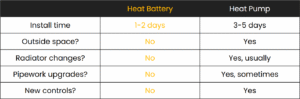
Because the ZEB stores energy internally as high-density heat, it has a massive amount of thermal energy ready to deploy. Once charged, it mimics the exact output of a gas, oil, or LPG boiler. This unique feature allows us to leave the rest of your home completely untouched.
As long as your current radiators and pipes work as expected, there is no need to tear them out:
-
Keep your radiators: The ZEB is simply configured to deliver the high flow temperatures required to keep your rooms perfectly toasty.
-
Keep your pipework: The installation team connects directly to the primary flow and return pipes left behind by your old boiler.
-
Keep your controls: The ZEB integrates seamlessly with your existing heating controls, whether you use a traditional dial thermostat, a standard programmer, or a smart thermostat system.
The entire installation process is straightforward. A heating engineer and an electrician remove your old boiler and connect the ZEB over just 1–2 days. The only major “new” requirement is a dedicated electrical supply run from your consumer unit to the ZEB’s location.
Smashing the “Expensive Electric Heating” Myth
The most persistent myth about electric heating is that it is inherently too expensive to run. Given that fossil fuels historically sit below 10p/kWh and standard electricity rates can exceed 25p/kWh, assuming an electric system will drive up bills is a completely reasonable concern.
This concern is entirely true for “direct electric” systems that lack thermal storage. If you heat your home in real-time during peak hours, bills will spike.
The ZEB changes the equation completely.
Instead of consuming electricity when demand on the grid is highest, the ZEB intelligently draws power during off-peak windows when electricity is at its cheapest and greenest. It stores this low-cost energy and releases it as heat strictly on demand.
With modern off-peak and smart time-of-use tariffs dropping as low as 7p/kWh, a smart heat battery can be significantly cheaper to run than traditional electric heating options. Swapping to a compatible smart tariff is a highly automated, straightforward process handled directly with your energy supplier.
Upfront Costs and New Financial Support
A simpler installation naturally yields a more accessible upfront price: fewer raw materials, less labor time, and zero structural disruption.
For context, the average UK heat pump installation cost roughly £13,200 in 2025. Even with a standard £7,500 Boiler Upgrade Scheme (BUS) grant applied, homeowners are left facing around £5,700 in out-of-pocket expenses, before factoring in any necessary radiator or pipe upgrades.
The tepeo ZEB costs £6,000 upfront. Better yet, from Winter 2026, eligible homes will be able to qualify for a newly expanded £2,500 government grant specifically targeting thermal storage innovation. And even better than that? tepeo is offering this £2,500 off up front for a limited time only.
Is Your Home Ready to Ditch Fossil Fuels?
Final installation costs naturally vary based on your property layout, your current pipework, and your hot water setup.
The fastest way to find out if a ZEB heat battery is the perfect match for your property is to use our quick, interactive assessment tool. It takes less than two minutes to complete.
👉 Take the 2-Minute ZEB Home Check
Have a few specific questions about your heating setup? Get in touch with our friendly team of experts today—we are always here to help.
Sources:
*Energy unit rates quoted are estimates for illustrative purposes only and representative at the time of writing in February 2026.
**MCS (https://mcscertified.com/consumers/technologies/heat-pumps/). Last accessed 03/02/2026.