
Replacing your boiler used to mean choosing between another gas boiler or making major changes to accommodate a low-carbon option, like a heat pump. Today, UK homeowners have another option.
Heat battery boilers provide whole-home heating using electricity stored as heat. Instead of drawing electricity whenever your heating comes on, like a direct electric boiler, heat batteries can charge during cheaper, lower-carbon periods and release that stored heat only when your home needs it.
For suitable homes, this creates a practical middle ground: familiar central heating without the ongoing use of fossil fuels.
Is a ZEB right for your home?
Enter your address for a quick check. We'll see whether a ZEB could work for your property and, if it does, show you an estimated quote.
Let's check your home details
PROPERTY DETAILS
Please choose your property type, floor area, build period, and main fuel below to calculate your estimate.
Good news! The ZEB is a match for your home.
Based on your estimated usage, a ZEB can comfortably heat your home.
While we aren't actively installing in your area today, we are expanding quickly. Leave your details below to join our priority waitlist and be first in line when we launch in your area.
Your home may not be a good fit for a ZEB
Based on our estimate, which considers your property size and available building records, your home's heat demand appears to be above the suitable range for a ZEB.
If you think this doesn't look right, you can check your latest energy bills and update the heat demand figure on this page. We'll then recheck your suitability and update your estimate.
Compares fuel consumption, standing charges, and annual maintenance vs your current boiler.
Tariff: Optimised on cheapest flexible tariff ().
Ready to take the next step?
Enter your contact details below to get an email with your estimate or book a quick, no-obligation call with one of our heating experts.
On the call, we'll review your home details, answer any questions, and help turn this estimate into a tailored quote. We'll also email you a copy of your estimate and report straight away.
Want to be added to the waiting list?
If you'd like to be notified as soon as we launch in your area, enter your contact details below to join our priority waitlist.
We'll email you a copy of your initial estimate and suitability report right away, and drop you a message as soon as installation opens in your area.
Still think the ZEB is right for you or just want to stay in touch?
If your actual usage is over 14,000 kWh, the ZEB could still work if you have secondary heating (like a wood burner or heat pump), a hybrid setup, or a 3-phase electrical supply. Please fill out your details below and one of our heating specialists will get in touch to discuss your options.
Please enter a valid phone number (min 10 digits)
Please enter a valid email address
We may occasionally email you with useful information about ZEB suitability, costs and tepeo services. You can opt out at any time.
By proceeding, you agree that tepeo will use your details to respond to your enquiry in accordance with our Privacy Policy.
Wet heating system: As your home does not currently have radiators or underfloor pipework, our heating engineer will also discuss options for installing wet central heating during your call.
Book a call with one of our experts
Choose a time that suits you and we'll talk through your home, your estimate and any questions you have about the ZEB.
✓ We've also emailed a copy of your initial estimate to
Prefer to speak now?
Give our team a direct call
Your estimate is on its way!
We're emailing your complete estimate and suitability report to . Please check your inbox shortly.
Why not book a call right now?
While you wait for your email, why not lock in a quick call with one of our heating experts? We can review your home's details together, answer any questions, and help turn your estimate into a bespoke installation quote.
Want to speak with our team?
If you have any questions or want to discuss bespoke heating arrangements, send us an email and one of our specialists will be pleased to help.
Is a ZEB right for your home?
Enter your address for a quick check. We'll see whether a ZEB could work for your property and, if it does, show you an estimated quote.
Let's check your home details
PROPERTY DETAILS
Please choose your property type, floor area, build period, and main fuel below to calculate your estimate.
Good news! The ZEB is a match for your home.
Based on your estimated usage, a ZEB can comfortably heat your home.
While we aren't actively installing in your area today, we are expanding quickly. Leave your details below to join our priority waitlist and be first in line when we launch in your area.
Your home may not be a good fit for a ZEB
Based on our estimate, which considers your property size and available building records, your home's heat demand appears to be above the suitable range for a ZEB.
If you think this doesn't look right, you can check your latest energy bills and update the heat demand figure on this page. We'll then recheck your suitability and update your estimate.
Ready to take the next step?
Enter your contact details below to get an email with your estimate or book a quick, no-obligation call with one of our heating experts.
On the call, we'll review your home details, answer any questions, and help turn this estimate into a tailored quote. We'll also email you a copy of your estimate and report straight away.
Want to be added to the waiting list?
If you'd like to be notified as soon as we launch in your area, enter your contact details below to join our priority waitlist.
We'll email you a copy of your initial estimate and suitability report right away, and drop you a message as soon as installation opens in your area.
Still think the ZEB is right for you or just want to stay in touch?
If your actual usage is over 14,000 kWh, the ZEB could still work if you have secondary heating (like a wood burner or heat pump), a hybrid setup, or a 3-phase electrical supply. Please fill out your details below and one of our heating specialists will get in touch to discuss your options.
Please enter a valid phone number (min 10 digits)
Please enter a valid email address
We may occasionally email you with useful information about ZEB suitability, costs and tepeo services. You can opt out at any time.
By proceeding, you agree that tepeo will use your details to respond to your enquiry in accordance with our Privacy Policy.
Wet heating system: As your home does not currently have radiators or underfloor pipework, our heating engineer will also discuss options for installing wet central heating during your call.
Book a call with one of our experts
Choose a time that suits you and we'll talk through your home, your estimate and any questions you have about the ZEB.
✓ We've also emailed a copy of your initial estimate to
Prefer to speak now?
Give our team a direct call
Your estimate is on its way!
We're emailing your complete estimate and suitability report to . Please check your inbox shortly.
Why not book a call right now?
While you wait for your email, why not lock in a quick call with one of our heating experts? We can review your home's details together, answer any questions, and help turn your estimate into a bespoke installation quote.
Want to speak with our team?
If you have any questions or want to discuss bespoke heating arrangements, send us an email and one of our specialists will be pleased to help.
What is a heat battery boiler?
A heat battery boiler uses electricity to heat a ceramic core inside the unit. This energy is stored efficiently and is then released into a wet central heating system to warm the home through radiators or underfloor heating.
Unlike a direct electric boiler, which generally uses electricity at the same time that heat is required, a heat battery boiler can charge in advance. This allows it to take advantage of cheaper off-peak electricity tariffs – especially useful if you’re already on an EV tariff, for example.
The tepeo ZEB is designed to replace the central heating side of a conventional boiler system while working with the radiators and existing pipework installed in many UK homes, making it super simple and familiar to get off fossil fuels and go low-carbon.
In simple terms: it charges like a battery and heats your home like a boiler.
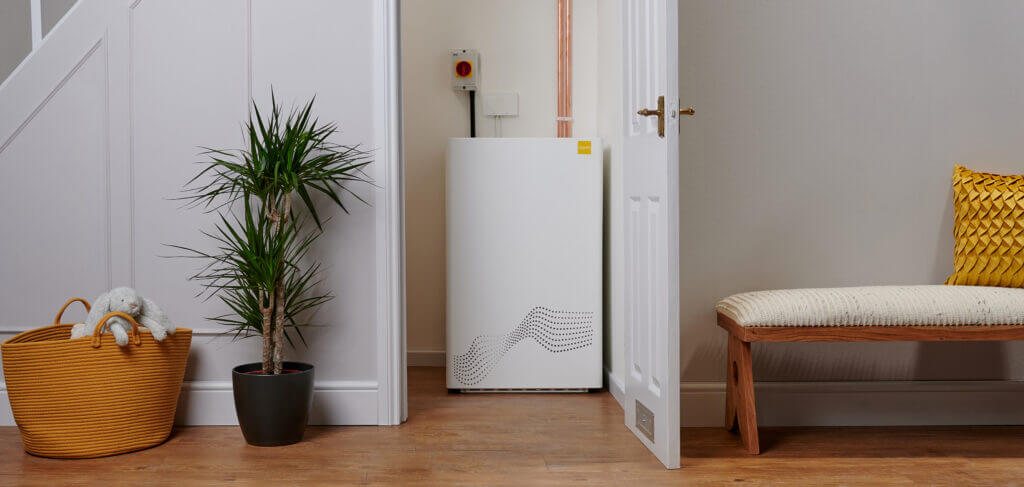
Here are some of the reasons more and more UK homeowners are switching to a heat battery boiler:
1. They provide a low-carbon alternative to gas, oil and LPG
Heating is one of the largest sources of household energy use, so moving away from fossil fuels can make a significant difference to a home’s carbon footprint.
Heat battery boilers do not burn gas, oil or LPG in the home. Instead, they use electricity, which is increasingly being generated from renewable and lower-carbon sources across Great Britain.
Smart charging can strengthen this benefit by prioritising periods when electricity is not only cheaper, but may also be less carbon intensive – rather than drawing all its power during periods of high demand.
This makes heat battery boilers an appealing option for homeowners who want to decarbonise their UK home heating without completely changing the way their central heating operates.
2. They can significantly reduce heating costs compared with direct electric boilers
One of the biggest differences between a direct electric boiler and a heat battery boiler is when the electricity is purchased.
A direct electric boiler must draw electricity when the home asks for heat. That may be during expensive peak periods, such as the early evening.
A heat battery boiler can instead charge during lower-cost off-peak windows and store that energy until it is needed. Time-of-use tariffs commonly offer different electricity prices at different times of day, giving households an opportunity to shift a large proportion of their heating demand away from peak rates.
For the best results, the system, home and tariff must be well matched. Heating costs will depend on factors including:
- The property’s annual heat demand
- Insulation and heat loss
- The chosen electricity tariff
- Heating habits and schedules
- How much charging can take place off peak
This means no technology can promise the same saving for every household. However, for a suitable property using an appropriate tariff, smart heat storage can offer meaningful heating cost reduction compared with conventional direct electric heating.
Electric Boilers vs Heat Battery Boiler
In this guide, we compare a direct electric boiler with a smart heat battery boiler, looking at cost, carbon, and real-world flexibility.
Energy Tariffs
Pair your tepeo boiler with the right electricity tariff to get the absolute best running costs and make the biggest dent in your carbon footprint.
3. Installation can be completed without designing the entire home
Many low-carbon heating projects involve more than replacing a single appliance. Depending on the property and heating design, homeowners may need to consider new radiators, changes to pipework, outdoor equipment or other upgrades.
The tepeo heat battery boiler is designed to integrate with the wet central heating system already found in many UK properties.
In a suitable home, the existing radiators and much of the existing pipework can often remain in place. A typical tepeo boiler installation takes around one to two days, although the exact work and timescale will always depend on the property.
This can make it a much less disruptive, particularly for homeowners who want to retain the familiar responsiveness and controls of a traditional central heating system.
Every home is different, so a suitability assessment should take place before installation.
4. They offer an option for homes where a heat pump may not be suitable
Heat pumps are an excellent low-carbon heating solution for many homes and should be considered wherever they are practical. However, not every homeowner is able, or ready, to install one.
Potential barriers can include:
- Limited outdoor space
- Planning or leasehold restrictions
- Concerns about positioning an external unit
- A heating system that would require wider changes
- The cost or disruption of modifying the home
- A home with heating needs that are not well suited to the proposed system design
Electric heat battery boilers provide another route away from fossil fuels for some of these households. Because a tepeo ZEB sits inside the property and connects to a wet central heating system, it does not require an outdoor unit or flue.
It is important to assess each property individually. A heat battery boiler is not automatically right for every home. The best solution depends on the building, heat demand, available space, budget and priorities of the homeowner.
Heat pump vs Heat Battery Boiler
Discover the differences between a heat pump and a heat battery boiler in this useful comparison guide.
5. Homeowners can keep familiar radiators and heating controls
Moving to low-carbon heating does not have to mean changing everything about how a home feels.
For many suitable properties, a heat battery boiler can continue supplying hot water to the existing radiator circuit. Homeowners can therefore retain the style of whole-home central heating they already understand: set the controls, turn on the heating and allow warm water to circulate through their radiators.
The tepeo boiler also includes app-based controls and smart charging features. It can use information about the weather, household requirements, and electricity tariffs to help determine how much energy to store and when to charge. The app also allows you to view all your charging data, amend charging times, and even allows you to turn off or boost (particularly useful if you travel a lot).
This combination of familiar heating and smarter energy management makes heat battery boilers attractive to people who want modern low-carbon technology without making their home feel unfamiliar.
6. They can make better use of flexible electricity tariffs
The UK energy system is changing. As more renewable electricity is added to the grid, energy suppliers are increasingly offering tariffs that reward customers for moving their electricity use away from the busiest periods.
Using electricity at peak times can be expensive. But a heat battery boiler can separate the point at which electricity is bought from the point at which the heat is used.
For homeowners who already have solar panels, an EV, a home battery or experience using smart tariffs, a heat battery boiler can become another part of a more flexible, electrified home.
7. They provide a future-focused whole-home heating solution
Replacing a boiler is a long-term decision. Many homeowners do not simply want the cheapest like-for-like replacement today; they want a system that supports the direction in which home energy is moving. Heat battery boilers can work alongside:
- Smart electricity tariffs
- Solar panels
- Renewable electricity
- Home energy management technology
- A progressively lower-carbon electricity grid
They can also help reduce reliance on volatile fossil fuel markets by replacing gas, oil or LPG heating with an electricity-based system.
For homeowners exploring gas boiler alternatives, this offers a way to electrify their heating while maintaining a recognisable boiler-and-radiator setup.
No single technology will be the answer for every UK property. Heat pumps, heat networks, heat batteries and other technologies will all have a role to play. The advantage of a heat battery boiler is that it adds another practical choice for homes that might otherwise replace an old fossil fuel boiler with another one.
Choosing the right replacement for your home
The right boiler replacement should reflect the home rather than simply following the most familiar option. For suitable homes, heat battery boilers offer 7 clear advantages:
- Lower-carbon heating without burning fossil fuels
- The potential to reduce costs
- A relatively fast and straightforward installation
- An alternative where a heat pump not be suitable
- Compatibility with existing radiators in many homes
- Access to cheaper, more flexible electricity tariffs
- A future-focused route to whole-home electrification
In addition to the above, tepeo is offering £2,500 off its heat battery boilers while the government finalises plans to include heat batteries in the Boiler Upgrade Scheme later this year. tepeo is also working closely with government to support the removal of VAT from heat batteries, helping make low-carbon heating more affordable and accessible for more UK households.
The next step is to check whether the technology matches your property and energy use.
Ready to find out whether your home is suitable? Complete our quick Home Check to explore your options.
Is a ZEB right for your home?
Enter your address for a quick check. We'll see whether a ZEB could work for your property and, if it does, show you an estimated quote.
Let's check your home details
PROPERTY DETAILS
Please choose your property type, floor area, build period, and main fuel below to calculate your estimate.
Good news! The ZEB is a match for your home.
Based on your estimated usage, a ZEB can comfortably heat your home.
While we aren't actively installing in your area today, we are expanding quickly. Leave your details below to join our priority waitlist and be first in line when we launch in your area.
Your home may not be a good fit for a ZEB
Based on our estimate, which considers your property size and available building records, your home's heat demand appears to be above the suitable range for a ZEB.
If you think this doesn't look right, you can check your latest energy bills and update the heat demand figure on this page. We'll then recheck your suitability and update your estimate.
Compares fuel consumption, standing charges, and annual maintenance vs your current boiler.
Tariff: Optimised on cheapest flexible tariff ().
Ready to take the next step?
Enter your contact details below to get an email with your estimate or book a quick, no-obligation call with one of our heating experts.
On the call, we'll review your home details, answer any questions, and help turn this estimate into a tailored quote. We'll also email you a copy of your estimate and report straight away.
Want to be added to the waiting list?
If you'd like to be notified as soon as we launch in your area, enter your contact details below to join our priority waitlist.
We'll email you a copy of your initial estimate and suitability report right away, and drop you a message as soon as installation opens in your area.
Still think the ZEB is right for you or just want to stay in touch?
If your actual usage is over 14,000 kWh, the ZEB could still work if you have secondary heating (like a wood burner or heat pump), a hybrid setup, or a 3-phase electrical supply. Please fill out your details below and one of our heating specialists will get in touch to discuss your options.
Please enter a valid phone number (min 10 digits)
Please enter a valid email address
We may occasionally email you with useful information about ZEB suitability, costs and tepeo services. You can opt out at any time.
By proceeding, you agree that tepeo will use your details to respond to your enquiry in accordance with our Privacy Policy.
Wet heating system: As your home does not currently have radiators or underfloor pipework, our heating engineer will also discuss options for installing wet central heating during your call.
Book a call with one of our experts
Choose a time that suits you and we'll talk through your home, your estimate and any questions you have about the ZEB.
✓ We've also emailed a copy of your initial estimate to
Prefer to speak now?
Give our team a direct call
Your estimate is on its way!
We're emailing your complete estimate and suitability report to . Please check your inbox shortly.
Why not book a call right now?
While you wait for your email, why not lock in a quick call with one of our heating experts? We can review your home's details together, answer any questions, and help turn your estimate into a bespoke installation quote.
Want to speak with our team?
If you have any questions or want to discuss bespoke heating arrangements, send us an email and one of our specialists will be pleased to help.
Is a ZEB right for your home?
Enter your address for a quick check. We'll see whether a ZEB could work for your property and, if it does, show you an estimated quote.
Let's check your home details
PROPERTY DETAILS
Please choose your property type, floor area, build period, and main fuel below to calculate your estimate.
Good news! The ZEB is a match for your home.
Based on your estimated usage, a ZEB can comfortably heat your home.
While we aren't actively installing in your area today, we are expanding quickly. Leave your details below to join our priority waitlist and be first in line when we launch in your area.
Your home may not be a good fit for a ZEB
Based on our estimate, which considers your property size and available building records, your home's heat demand appears to be above the suitable range for a ZEB.
If you think this doesn't look right, you can check your latest energy bills and update the heat demand figure on this page. We'll then recheck your suitability and update your estimate.
Ready to take the next step?
Enter your contact details below to get an email with your estimate or book a quick, no-obligation call with one of our heating experts.
On the call, we'll review your home details, answer any questions, and help turn this estimate into a tailored quote. We'll also email you a copy of your estimate and report straight away.
Want to be added to the waiting list?
If you'd like to be notified as soon as we launch in your area, enter your contact details below to join our priority waitlist.
We'll email you a copy of your initial estimate and suitability report right away, and drop you a message as soon as installation opens in your area.
Still think the ZEB is right for you or just want to stay in touch?
If your actual usage is over 14,000 kWh, the ZEB could still work if you have secondary heating (like a wood burner or heat pump), a hybrid setup, or a 3-phase electrical supply. Please fill out your details below and one of our heating specialists will get in touch to discuss your options.
Please enter a valid phone number (min 10 digits)
Please enter a valid email address
We may occasionally email you with useful information about ZEB suitability, costs and tepeo services. You can opt out at any time.
By proceeding, you agree that tepeo will use your details to respond to your enquiry in accordance with our Privacy Policy.
Wet heating system: As your home does not currently have radiators or underfloor pipework, our heating engineer will also discuss options for installing wet central heating during your call.
Book a call with one of our experts
Choose a time that suits you and we'll talk through your home, your estimate and any questions you have about the ZEB.
✓ We've also emailed a copy of your initial estimate to
Prefer to speak now?
Give our team a direct call
Your estimate is on its way!
We're emailing your complete estimate and suitability report to . Please check your inbox shortly.
Why not book a call right now?
While you wait for your email, why not lock in a quick call with one of our heating experts? We can review your home's details together, answer any questions, and help turn your estimate into a bespoke installation quote.
Want to speak with our team?
If you have any questions or want to discuss bespoke heating arrangements, send us an email and one of our specialists will be pleased to help.