When choosing a new heating system, the priority is simple: you want your home to be warm, reliable and affordable to run – while making a choice that is better for the planet, too.
For many households, electric heating sounds like a sensible step. It removes emissions from the home, avoids a flue, and can feel like a straightforward alternative to gas, oil or LPG.
But there is an important difference between using electricity for heating and using electricity smartly.
A standard electric boiler uses electricity at the exact moment your home needs heat. A smart heat battery boiler, like the tepeo ZEB, charges when electricity is cheaper (and often cleaner), stores that energy as heat, and then releases it when your home needs warmth and hot water.
You still get the familiar comfort of central heating: radiators, hot water, warm home… the difference is that the ZEB does the smart timing in the background.
That timing matters because it can affect your running costs, your carbon emissions, and how ready your home is for the future of electricity.
In this guide, we compare a direct electric boiler with a smart heat battery boiler, looking at cost, carbon and real-world flexibility.
Quick answer: is a heat battery boiler better than an electric boiler?
For many homes, yes. A heat battery boiler can be significantly cheaper to run than a standard electric boiler because it can charge during off-peak electricity periods and deliver heat later.
Based on tepeo modelling for a 40kWh ZEB compared with a direct electric boiler. That is because it can avoid drawing most of its electricity from the grid during morning and evening peaks, when demand is often higher and electricity can be more carbon intensive.
Put simply:
- An electric boiler heats when your home asks for heat.
- A heat battery boiler charges when electricity is cheaper and often cleaner.
- Your home still gets the heating experience you know.
- The smart charging happens quietly in the background.
What is an electric boiler?
An electric boiler uses electricity to heat water for your radiators and hot water systems. It is often seen as a straightforward alternative to gas, oil or LPG boilers because it can work with a wet central heating system and does not produce emissions in the home.
For some homes, that simplicity is appealing. The challenge is often the running cost.
Most homes need heat in the early morning and evening. Those are also the times when electricity demand is often highest. When demand rises, electricity is often more expensive, and the grid may need to rely on higher-carbon generation to meet that demand.
So while a direct electric boiler can be simple to install, it can also be expensive to run – especially in homes with higher heating needs.
What is a heat battery boiler?
A heat battery boiler is a low-disruption electric heating system that stores energy as heat.
The tepeo ZEB works with your existing radiators and hot water cylinder, much like a boiler, but it charges intelligently when electricity is cheaper and cleaner. It then uses stored heat to keep your home warm when you need it.
A simple way to explain it is: a heat battery boiler charges like a battery and heats like a boiler.
That makes it especially useful for households who want to move away from fossil fuels without changing everything about the way their home is heated.
It can also be a practical option for people who have looked at a heat pump and found it was not the right fit for their home, budget or installation plans.
Why timing matters for electric heating
Electricity is getting cleaner. In 2024, the UK’s electricity generation reached a record low carbon intensity, helped by the continued growth of renewables and the end of coal power generation. That is good news for anyone looking at electric heating.
But there is a second point that matters just as much: electricity is not equally clean all the time.
At some points in the day, the grid has more renewable power available and electricity is lower carbon. At other times, demand is higher and the grid can become more carbon intensive.
So the carbon impact of electric heating is not just about how much electricity you use: it is also about when you use it.
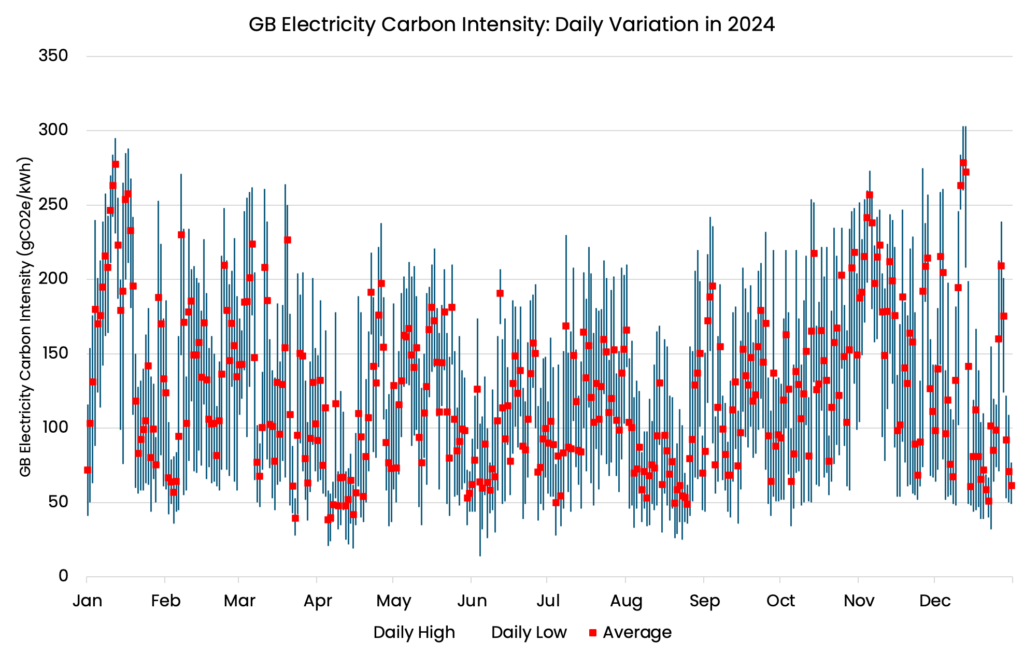
GB electricity carbon intensity varies throughout the year, creating opportunities for flexible heating systems to charge when electricity is cleaner.
The same principle applies to cost. Flexible tariffs reward households that can shift electricity use away from peak periods. A standard electric boiler cannot do much of that because it needs electricity when the home needs heat. A heat battery boiler can.
Electric boiler vs ZEB: carbon emissions compared
Electric heating systems do not product carbon emissions at the point of use. That is a major benefit compared with gas, oil or LPG heating. But electricity still has indirect emissions from the way it is generated. For a direct electric boiler, those emissions depend on how clean the grid is at the time the heating is running.
In a typical home, heating demand is concentrated in the morning and evening. These are often busy periods for the grid. A smart heat battery boiler can reduce emissions by charging more of the time when grid electricity is cleaner.
For a typical 2-3 bedroom semi-detached property using around 8MWh of heat per year, tepeo modelling found:
That means, in this example, the direct electric boiler creates around 50% more indirect carbon emissions than a ZEB heat battery boiler. A gas boiler creates around twice the emissions of the ZEB, and those emissions happen directly at the home.
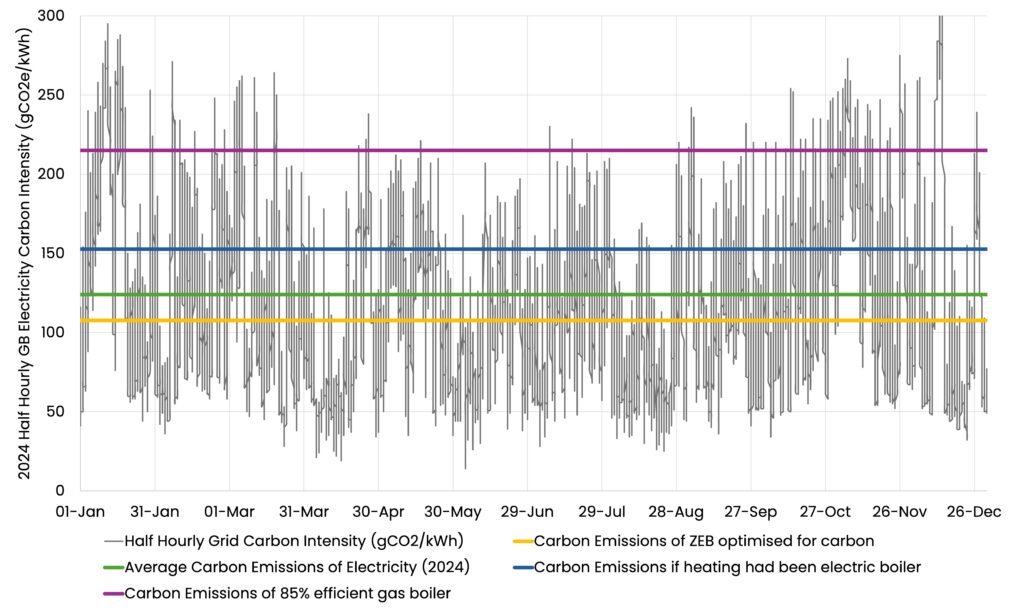
A ZEB can charge when grid electricity is lower carbon, reducing indirect emissions compared with direct electric heating.
Electric boiler vs ZEB: running costs compared
This is where the difference becomes very practical for households. It is not just about how the system works – it is about what that means for your bill at the end of every month.
To compare the two systems fairly, tepeo modelled a 40kWh ZEB against an electric flow boiler using heating-only costs. The electric boiler was modelled on a flat electricity rate of around 27p/kWh, while the ZEB was optimised for cost using an E.ON Next Drive-style tariff, with off-peak electricity at 6.7p/kWh and a day rate just over 27p/kWh.
The result is a clear gap in annual running costs, especially as a home’s heat demand increases.
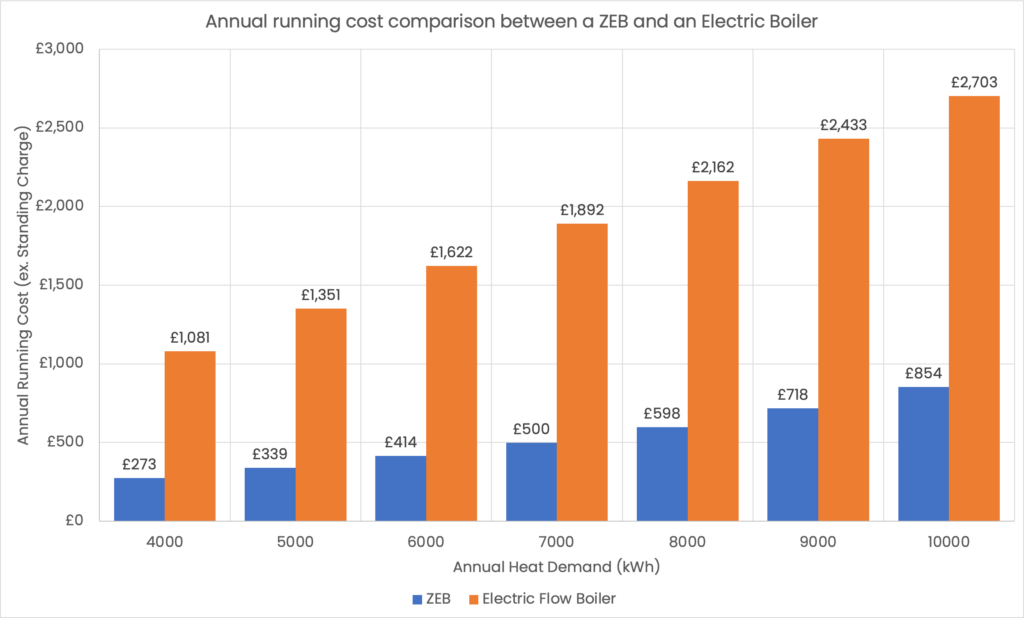
In this model, the ZEB heat battery boiler has substantially lower annual heating running costs than an electric flow boiler across a range of annual heat demands.
| Annual heat demand | ZEB annual running cost | Electric boiler annual running cost | Estimated annual saving |
|---|---|---|---|
| 4,000kWh | £273 | £1,081 | £808 |
| 5,000kWh | £339 | £1,351 | £1,012 |
| 6,000kWh | £414 | £1,622 | £1,208 |
| 7,000kWh | £500 | £1,892 | £1,392 |
| 8,000kWh | £598 | £2,162 | £1,564 |
| 9,000kWh | £718 | £2,433 | £1,715 |
| 10,000kWh | £854 | £2,703 | £1,849 |
For a home using 8,000kWh of heat per year, that is an estimated saving of more than £1,500 per year compared with a direct electric boiler. The ZEB’s 40kWh figure refers to how much heat it can store at one time, not how much the home uses over the year.
For households already struggling with high electric boiler bills, this is the real difference smart charging can make. You do not have to use electricity at the most expensive times just because that is when your home needs heat.
Why smarting heating matters more than simple electric heating
The key difference is not whether a heating system uses electricity. It is whether it can use electricity intelligently.
A direct electric boiler is simple, but that simplicity limits how much control you have over running costs. A heat battery boiler gives your home more flexibility, which can make electric heating more practical for everyday households.
That is why the ZEB is not just an electric boiler alternative. It is a smarter way to use electric heating – keeping the comfort people expect from a boiler, while helping reduce the cost and carbon compromises that often come with direct electric systems.
EV-style tariff vs heat pump-style tariffs: which works best with a ZEB?
Different tariffs suit different homes. An EV-style tariff, such as E.ON Next Drive, typically offers one very cheap off-peak window, often overnight. This can work very well for a ZEB because it can store a large amount of heat and use it later.
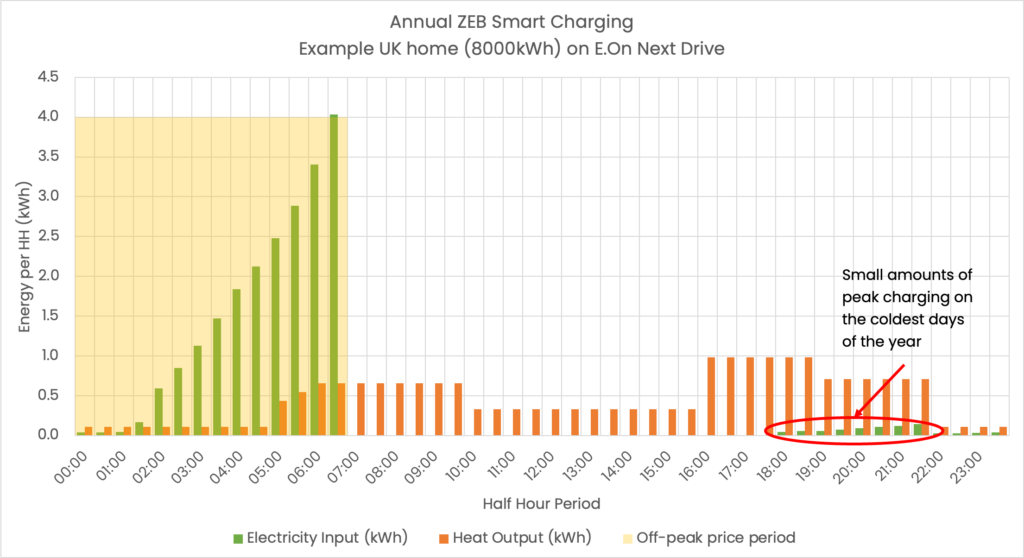
With an EV-style tariff, most ZEB charging can happen overnight. Small amounts of peak charging may be needed on the coldest days of the year, for example.
A heat pump-style tariff, such as Octopus Cosy, usually offers several lower-cost periods throughout the day. This can help avoid peak charging on very cold days by giving the ZEB more than one opportunity to top up.

A multi-rate tariff gives the ZEB more charging windows, helping reduce peak charging during high-demand periods.
In many cases, a simple two-rate EV tariff may still be more cost-effective because the off-peak rate is so low. But the best tariff will depend on the home, its heat demand, occupancy patterns and available smart tariff options.
The important point is choice. A ZEB gives your home the flexibility to make better use of tariffs as they charge over time.
| What to compare | Electric boiler | Heat pump | Heat battery boiler |
|---|---|---|---|
| How it heats your home | Uses electricity to heat water directly | Moves heat from outside into the home | Stores electricity as heat then releases it when needed |
| Eco credentials | Usually higher-carbon peak electricity | Low-carbon heating with emissions at home | Low-carbon electric heating with no emissions at home |
| Installation | Usually simple in suitable homes | Can be more involved and may need system changes | Usually simple in suitable homes |
| Day-to-day feel | Familiar central heating | Different heating pattern: lower temperature, longer running | Familiar boiler-like heating experience |
| Running cost factors | Can often be costly if used at peak electricity rates | Can be efficient and cost-effective in suitable homes | Designed to charge using cheaper off-peak electricity |
| Support available | Usually no BUS grant | £7,500 BUS grant | BUS grant support coming winter 2026 with £2,500 tepeo early grant match available |
The key point is not that one technology should replace every other technology. The point is that homeowners need more than two options. For many homes, a heat battery boiler could be a missing middle: more familiar than a heat pump, smart than a direct electric boiler, and cleaner than a gas boiler.

Calculate your savings by switching
Use our savings calculator to check how the ZEB compares to your existing boiler in terms of running costs and carbon emissions.
Who should consider switching from an electric boiler to a ZEB?
You could consider a heat battery boiler if:
- You currently use an electric boiler and your heating bills are high.
- You want to move away from gas, oil or LPG without replacing your full central heating system.
- You have been told a heat pump may not be suitable for your home.
- You want to use smart tariffs to reduce heating costs.
- You want zero-emission heating at the point of use.
- You like the familiarity of a boiler and wet radiators.
- You want a system that can adapt as electricity becomes cleaner, smarter and more flexible.
The ZEB is designed to keep the familiar parts of home heating – radiators, warmth, hot water and control – while changing the way the energy is bought and stored. It is a better boiler powered by smart electricity, all of which you can control via an app.

Hear from our customers
Discover our range of customer case studies here.
The future of heating is flexible
The UK electricity system is becoming cleaner, but also more variable. More renewable power means there will be more moments when electricity is cheap and low carbon, and more moments when flexibility matters. That is why flexible electric heating is so important.
A direct electric boiler electrifies heat, but it does not make heating flexible. A heat battery boiler does both.
For households, that can mean lower bills and lower carbon. For a wider energy system, it can help reduce demand at peak times and make better use of renewable energy.
This is the bigger idea behind the ZEB: warmth without the waste, and progress without the disruption homeowners often fear.
Final verdict: electric boiler vs heat battery boiler
A direct electric boiler can look like a simple route away from fossil fuel heating, but it comes with two major compromises: cost and carbon. A smart heat battery boiler like the ZEB is designed to solve both. For many homes, that means:
- Much lower running costs than a direct electric boiler.
- Lower indirect carbon emissions.
- No emissions at the point of use.
- Familiar central heating with existing radiators.
- A low-disruption alternative where heat pumps may not be the right fit.
- More flexibility as smart tariffs and renewable electricity grow.
If you are currently heating your home with an electric boiler, you could be spending far more than you need to.

See if the ZEB is right for your home
Check your home to see whether a ZEB could help you reduce heating costs and carbon emissions with our 60-second Home Checker tool.
FAQs
Is an electric boiler expensive to run?
Electric boilers can be expensive to run because they use electricity at the moment heat is needed. In many homes, that means running during morning and evening peak periods, when electricity is often more expensive.
Is a heat battery boiler cheaper than an electric boiler?
A heat battery boiler can be much cheaper to run than a direct electric boiler when paired with a suitable smart tariff. Tepeo modelling suggests a ZEB could save many households between £800 and £2,000 per year compared with an electric flow boiler, depending on heat demand and tariff.
Does a ZEB work with existing radiators?
Yes. The ZEB is designed to work with familiar wet central heating systems, including radiators and a hot water cylinder, making it a lower-disruption option for many homes.
Does a heat battery boiler produce emissions in the home?
No. Like other electric heating systems, a heat battery boiler produces no carbon emissions at the point of use. Its indirect emissions depend on the electricity used to charge it.
Why is a ZEB lower carbon than an electric boiler?
A ZEB can charge when electricity is cleaner and avoid drawing most of its power from the grid during higher-demand periods. A direct electric boiler uses electricity on demand, which often means running during morning and evening peaks.
Is a heat battery boiler the same as a heat pump?
No. A heat pump uses electricity to move heat from outside into the home. A heat battery boiler stores electricity as heat and releases it through a wet central heating system. Both are electric heating options, but they work differently and suit different homes.
What is the best tariff for a ZEB?
The best tariff depends on your home and usage. EV-style tariffs with very cheap overnight rates can work well because the ZEB can charge overnight. Multi-rate tariffs can also work well because they offer more charging windows during the day.