

For households that rely on heating oil, the cost of staying warm can change dramatically in a matter of weeks.
Earlier this year, average UK heating oil prices rose from around 64p per litre in February to 104p per litre in March. By April, they had peaked at around 123p per litre.
For a typical 500-litre delivery, that meant the cost rose from approximately £320 to £520 in just one month.
For households in rural and off-gas-grid areas, that is not an abstract movement in the energy market. It is an extra £200 that has to be found simply to keep the heating on and the hot water running in their homes.
And around 1.5 million UK households rely on heating oil to do exactly that.
As winter approaches, many homeowners are understandably asking whether there is another way.
Why are heating oil prices so unpredictable?
Heating oil is closely tied to international oil markets.
When crude oil and wholesale fuel prices rise because of global supply disruption, conflict or sudden changes in demand, those increases can quickly feed through to the price paid by households.
The relationship is visible in government energy data, where charts show the sharp increases in both crude oil prices and the retail price of standard burning oil during periods of international energy-market disruption.
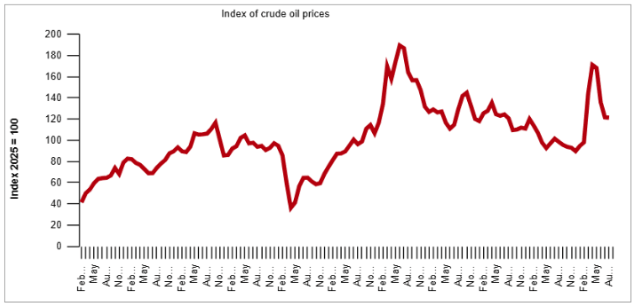
UK Government, Energy Prices Road Fuels and Other Petroleum Products, 29/09/2026
That matters because an oil-heated household has relatively little control over those movements.
You can reduce how much heating you use. You can shop around between suppliers. You can sometimes time a delivery when prices are lower.
But ultimately, the price of the fuel itself is being shaped by a global market.
The CMA found that 83% of the increase in retail heating oil prices between February and March 2026 came from higher wholesale costs. That leaves oil-heated households particularly exposed to movements in the price of a globally traded fossil fuel.
Electrified heating isn’t immune to changing energy prices either, but technologies such as heat batteries can give households more flexibility over when they buy their energy by making use of cheaper off-peak electricity.
From around 20p a litre to more than £1
The longer term picture makes the volatility even clearer.
During the exceptional fall in oil demand at the start of the Covid pandemic, heating oil briefly dropped to around 20p per litre.
Recent prices have been more than five times that level at their peaks.
That does not mean oil has simply risen fivefold in a straight line since 2020 – the 2020 price was extraordinarily low – but it does demonstrate the scale of the swings oil heated households have experienced in only a few years. And those swings can have a very real impact on household budgets.
To illustrate what those price changes could mean over a year, consider a household using 1,000 litres of heating oil. At different oil prices, that same annual usage could cost:
- At 20p/litre: around £200 per year
- At 64p/litre: around £640 per year
- At 104p/litre: around £1,040 per year
- At 123p/litre: around £1,230 per year
Households are unlikely to buy a full year’s supply at one fixed price, and the 20p/litre figure was an exceptional pandemic-era low. But the comparison shows just how exposed oil-heated homes can be when prices move sharply.
Even the jump from 64p to 104p per litre would add around £800 a year to the cost of the same 2,000 litres of fuel.
For households simply trying to keep their homes warm, that level of volatility can make heating costs much harder to predict and budget for.
Staying warm shouldn’t depend on guessing the oil market
Nobody should be sitting at home in January wondering whether they can afford to turn the heating on because they happened to need an oil delivery during a price spike.
Yet that anxiety is a very real part of oil heating for some households.
If rising oil prices are making you question whether you want to keep relying on oil, now is a good time to look at the alternatives.
Replacing an oil boiler no longer has to mean installing another one. Moving to electric heating can remove your dependence on delivered heating oil altogether – and there is now more than one way to make that switch.
Heat pumps are one option. Heat battery boilers, such as the ZEB, are another – offering a way to move away from oil while keeping the familiar radiators and wet central heating system already in your home.
For homeowners who want cleaner heating and freedom from the oil tank, the transition away from oil can start now.
Try our Cost and Carbon Calculator →

A heat battery boiler: an alternative to oil heating
For homeowners looking to move away from oil, a heat battery boiler can offer a very different way to heat the home without giving up the familiar central heating system they already use.
The tepeo ZEB charges like a battery and heats like a boiler. It stores electricity as heat inside its thermal core, then releases that heat through the home’s existing wet central heating system when it’s needed.
For oil-heated households, that can make the transition feel relatively familiar. Radiators still warm the home, the thermostat still controls the temperature, and hot water can still be provided through a cylinder.
What changes is the energy source.
Instead of storing hundreds or thousands of litres of heating oil and being exposed to the whims of the oil market when it’s time to fill up, the home is heated using electricity.
Why can a ZEB work well in an oil-heated home?
Many rural properties already have exactly the kind of heating infrastructure a tepeo ZEB heat battery boiler is designed to work with: a wet central heating system serving radiators or underfloor heating.
The ZEB can deliver flow temperatures of up to 80°C and up to 15kWh of heat output, meaning that in a suitable property it can work with an existing radiator system rather than requiring homeowners to redesign how their home is heated.
There is also no outdoor unit, which can be important for households wanting to reclaim their outdoor space.
For someone replacing an oil boiler, the appeal is therefore not just moving away from fossil fuels. It’s being able to do so while keeping much of the heating experience they’re already comfortable with.
What about running costs?
Moving from oil to electricity changes the way heating costs work.
A standard electric boiler uses electricity at the same time the home needs heat. A heat battery, like the tepeo ZEB, can instead store energy when electricity is cheaper and use that heat later.
The ZEB’s smart charging technology is designed to take advantage of time-of-use electricity tariffs, charging during cheaper periods while making sure enough heat is stored for the home’s needs.
That means the cost of running a ZEB is influenced by several things, including the property’s heat demand, the electricity tariff, and how much energy can be shifted into lower-cost charging periods.
This is particularly important when comparing a heat battery with oil.
Heating-oil households are exposed to changes in the price of delivered fuel. A heat battery works differently: because it can store heat, it can make use of cheaper off-peak electricity rather than relying solely on electricity at the moment the home needs heating.
The difference this can make depends heavily on the home and tariff – but Dan’s experience gives us a useful real-world example…
From oil to a tepeo heat battery boiler: Dan’s experience
Dan lives in a two bedroom terraced home in Kent and previously relied on an oil boiler, with a large kerosene tank taking up space in the garden.
Wanting to move away from oil, he looked at low-carbon alternatives. An air source heat pump was difficult because of the limited outdoor space available, so he chose a tepeo ZEB instead.
Since switching, Dan has been able to heat his home using electricity stored as heat, while continuing to use a familiar wet central heating system.
Between August 2025 and July 2026, his ZEB used around 3,652kWh of electricity at a cost of approximately £226, with an average charging cost of around 6.35p/kWh by making use of cheaper off-peak electricity.
Before switching, Dan estimated he was spending around £600 a year on oil at 2021 prices.
His experience is a good example of how a heat battery can give some oil-heated households another route away from oil.
Dan’s home, heating demand and tariff are specific to him, so these figures shouldn’t be taken as representative of every ZEB installation, but they show the savings that smart charging can make possible in the right circumstances.
What about a heat pump?
Heat pumps are another important low-carbon option for homeowners looking to move away from oil.
They work by extracting heat from the outside air or ground and can be highly efficient when correctly designed and installed.
They are also currently supported through the Boiler Upgrade Scheme, which provides grants towards eligible installations. Off-gas-grid households replacing oil or LPG can currently access particularly generous support.
For many rural properties, a heat pump will be a very good solution. But it is not the only route to electric heating.
Some homeowners may prefer a system that keeps higher temperature wet central heating, does not require an outdoor unit, or feels more similar to the boiler system they currently have.
The government has also announced plans to introduce £2,500 Boiler Upgrade Scheme support for heat batteries, once the required standards and eligibility criteria are in place. In the meantime, tepeo is offering its own £2,500 Early Grant Match for ZEB installations.
More choice for homes moving away from oil
The important change for oil-heated households is that replacing an oil boiler no longer has to mean installing another oil boiler.
Heat pumps provide one route away from fossil fuel heating.
Heat battery boilers provide another – particularly for homeowners who want to electrify their heating while retaining a familiar wet central heating system.
For rural households facing unpredictable oil prices, that choice really matters.
It means moving away from oil can be less about compromising on warmth or comfort and more about finding the heating system that works best for the home.
Could a ZEB replace your oil boiler?
If you’re considering moving away from oil, start by finding out whether your home could be suitable for a heat battery boiler.
Complete our 30-second Home Check to see whether a tepeo ZEB could work in your home and get your estimate.
Loading calculator...